

I C T Schools and Project, Computer Education, Andhra Pradesh India
Showing posts with label యాక్ట్ శ్రీకాకుళం. Show all posts
Showing posts with label యాక్ట్ శ్రీకాకుళం. Show all posts
Monday, February 17, 2020


Wednesday, June 6, 2018


Tuesday, June 5, 2018

Sunday, June 3, 2018
కంప్యూటర్ విద్య అంతేనా?
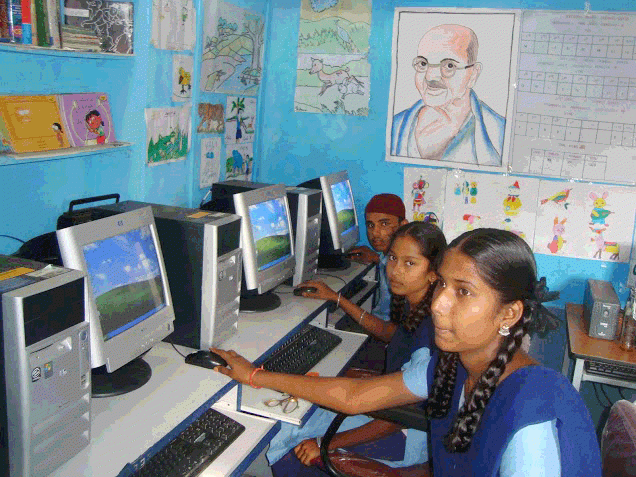
కంప్యూటర్ ఇన్స్స్ట్రక్టర్స్ ఎక్కడా..?
ప్రస్తుత సీసీఈ విధానంతో ఉన్న రికార్డులు, పరీక్షల నిర్వహణ, ప్రయోగాలు చేయడానికే సమయం లేదంటే మళ్లీ కంప్యూటర్ విద్యను బోధించడం సాధ్యం కాదనే అభిప్రాయాలున్నాయి. గతంలో ఎన్ఐఐటీ వాళ్లకు కంప్యూటర్ విద్య అందించడానికి ఇచ్చిన విధానం మాదిరి మళ్లీ ఏదేని సంస్థతో కంప్యూటర్ విద్యను అందించేందుకు విద్యాసంవత్సరం ఆరంభంలో చేయాలని సూచిస్తున్నారు.
Tuesday, May 29, 2018

Monday, May 28, 2018
RTI Commission - Continuation and Payment of salaries for Outsourcing and Contract Employees
RTI Commission - Continuation and Payment of salaries for Outsourcing and Contract Employees
 The Right To Information Act. has implemented in 2005. Accordingly, every state has established RTI
 - Commission.
- The Commission has established in the United AP. After bifurcation, the RTI Commission has not been established in Andhra Pradesh.
- Both the states of "Outsourcing and Contract Employees" are working in the Commission in the state of Telangana.
- Some of the Outsourcing and Contract Employees working in the RTI Commission have approached to the High Court for "Continuation and Payment of Salaries".
- The petition has taken by the High Court and proceeded for the arguments on 11th August 2017.

The Hon'ble High Court has ordered the TS Government for Continuing and Pay the salaries to employees.
- As per the bifurcation ratio, the Court has ordered to pay the salaries in the ration 58:42.
- The Hon'ble High Court has stated that by the reason of not bifurcating the Commission, It is not correct to throw employees out.
- The Govt. Pleader of Telangana State has stated that all the Commissioners will be recruited with in 6 weeks and also be continuing the employees duly paying the salaries in the ratio 58:42.
- In the meanwhile, the AP Govt. Pleader has argued that this is not possible because the Commission has not been bifurcated yet.
- In the circumstances, the Hon'ble HIgh Court has ordered to establish the Commission for Andhra Pradesh and also continuing and paying the salaries to the employees.
Sunday, May 27, 2018

Saturday, May 26, 2018
WHAT ARE THE RULES AND GUIDELINES FOR AP OUTSOURCING EMPLOYEES?
 The selection and recruitment process of AP Outsourcing Employees would take under contract Labour Rules & Act. The outsourcing posts will be filled in the existing vacancy of the Government employees vacancies. These employees work equally with the Government regular employees. These outsourcing posts will not be recruited directly by the Government. The third-party agency will recruit outsourcing employees on the demand of the Departments under the financial concurrence of the Finance Department. The following is the committee has been constituted for selection of agencies
 AP Outsourcing Guidelines and Rules:

Friday, May 25, 2018
ENHANCEMENT OF SALARY FOR AP OUTSOURCING EMPLOYEES 2018 | G.O.MS.NO. 7

The AP Government have issued orders in the G.O.Ms. 151, Finance (HR-1.Plg-Policy) Department, dated: 08.08.2016, stating that the Outsourcing personnel working in the AP State have enhanced the salaries in the three categories and the employees are getting remuneration as Rs. 12,000/-, Rs. 15,000/- and Rs. 17,500/- according to their category including Data Entry Operator (DEO), Data Processing Officer (DPO).
Wednesday, May 23, 2018


Sunday, May 20, 2018
Public-private partnership (PPP)
Public-private partnership (PPP) is a funding model for a public infrastructure project such as a new telecommunications system, airport or power plant. The public partner is represented by the government at a local, state and/or national level. The private partner can be a privately-owned business, public corporation or consortium of businesses with a specific area of expertise.
PPP is a broad term that can be applied to anything from a simple, short term management contract (with or without investment requirements) to a long-term contract that includes funding, planning, building, operation, maintenance and divestiture. PPP arrangements are useful for large projects that require highly-skilled workers and a significant cash outlay to get started. They are also useful in countries that require the state to legally own any infrastructure that serves the public.
Different models of PPP funding are characterized by which partner is responsible for owning and maintaining assets at different stages of the project. Examples of PPP models include:
- Design-Build (DB): The private-sector partner designs and builds the infrastructure to meet the public-sector partner's specifications, often for a fixed price. The private-sector partner assumes all risk.
- Operation & Maintenance Contract (O & M): The private-sector partner, under contract, operates a publicly-owned asset for a specific period of time. The public partner retains ownership of the assets.
- Design-Build-Finance-Operate (DBFO): The private-sector partner designs, finances and constructs a new infrastructure component and operates/maintains it under a long-term lease. The private-sector partner transfers the infrastructure component to the public-sector partner when the lease is up.
- Build-Own-Operate (BOO): The private-sector partner finances, builds, owns and operates the infrastructure component in perpetuity. The public-sector partner's constraints are stated in the original agreement and through on-going regulatory authority.
- Build-Own-Operate-Transfer (BOOT): The private-sector partner is granted authorization to finance, design, build and operate an infrastructure component (and to charge user fees) for a specific period of time, after which ownership is transferred back to the public-sector partner.
- Buy-Build-Operate (BBO): This publicly-owned asset is legally transferred to a private-sector partner for a designated period of time.
- Build-lease-operate-transfer (BLOT): The private-sector partner designs, finances and builds a facility on leased public land. The private-sector partner operates the facility for the duration of the land lease. When the lease expires, assets are transferred to the public-sector partner.
- Operation License: The private-sector partner is granted a license or other expression of legal permission to operate a public service, usually for a specified term. (This model is often used in IT projects.)
- Finance Only: The private-sector partner, usually a financial services company, funds the infrastructure component and charges the public-sector partner interest for use of the funds.
Saturday, May 19, 2018
హక్కు కింద పొందే సమాచారం కోసం దరఖాస్తు ఫార్మాట్ సమాచార హక్కు చట్టం, 2005
మీరు కూడా ఏ ( మీ ) సమస్యల గురించి తెలుసుకోవాలనుకుంటున్నారా అయితే ఆలస్యం చేయకండి ...
Friday, May 18, 2018

Thursday, May 17, 2018
Wednesday, May 16, 2018


Subscribe to:
Posts (Atom)